
Top 10 Network Transceivers Ranked

Best for: Ideal for network engineers needing reliable high-speed connections between devices.
Pros
Cons

Best for: Perfect for IT professionals who demand high bandwidth in data centers.
Pros
Cons

Best for: Best suited for enterprises needing ultra-fast connections in high-performance computing environments.
Pros
Cons

Best for: Tailored for long-range network operations in professional environments.
Pros
Cons

Best for: Designed for network professionals upgrading legacy cabling to higher speeds.
Pros
Cons
![[2 Pack] 1.25/2.5/5/10G SFP+ to RJ45 Transceiver, Copper SFP+ Module, Cat.6a/7,](https://m.media-amazon.com/images/I/61uzRYKW+AL._AC_SX679_.jpg)
Best for: Ideal for businesses needing versatile, high-speed connectivity without extensive cabling changes.
Pros
Cons

Best for: Great for IT departments looking for a reliable multimode fiber solution.
Pros
Cons

Best for: Perfect for users of Ubiquiti networks seeking reliable, high-speed fiber connections.
Pros
Cons
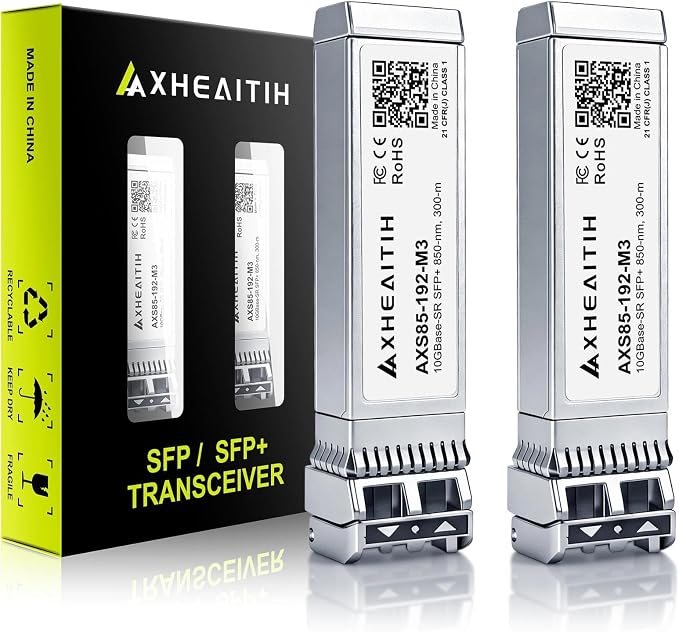
Best for: Best for teams needing multiple optical modules for seamless network upgrades.
Pros
Cons
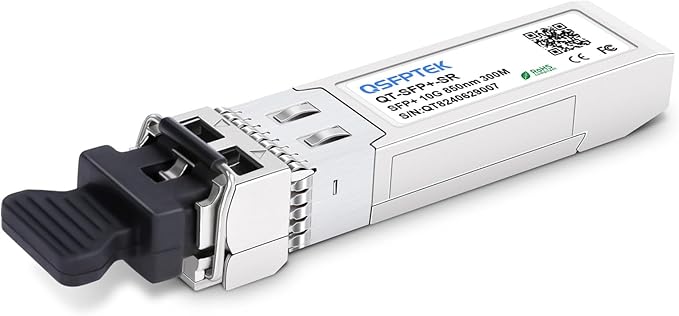
Best for: Ideal for users looking for a cost-effective solution for high-speed fiber applications.
Pros
Cons
Frequently Asked Questions
What is a network transceiver?
A network transceiver (also called an SFP or SFP+ module) is a small hot-pluggable optical or copper module that slots into compatible switches, routers, and servers to provide network connectivity. They are common in business and data centre environments where flexibility in connection type matters, allowing the same switch to support copper Ethernet, short-range fibre, or long-range single-mode fibre connections by swapping modules. For home use, transceivers are rarely needed unless you are working with enterprise networking equipment.
What is the difference between SFP and SFP+ transceivers?
SFP (Small Form-factor Pluggable) modules support speeds up to 1 Gbps and are used in standard Gigabit networking equipment. SFP+ modules support 10 Gbps and are used in 10 Gigabit switches and servers. The physical form factor is the same, so SFP+ slots are usually backwards compatible with SFP modules at reduced speeds. QSFP and QSFP+ formats handle 40 Gbps and higher speeds in data centre environments. For small business and prosumer networking, SFP+ at 10 Gbps is the relevant standard.
Are third-party transceivers compatible with name-brand switches?
Many enterprise switch brands like Cisco and Juniper use software locks that reject non-OEM transceivers by default, displaying compatibility warnings or refusing to enable the port. Third-party vendors like FS.com, Finisar, and ProLabs produce transceivers coded to pass OEM compatibility checks on specific switch models. Always verify compatibility with your exact switch model and firmware version before purchasing third-party modules. For open-networking switches and brands like Mikrotik, third-party transceivers typically work without restriction.
Do I need fibre optic transceivers for a home network?
For most home networks, no. Standard copper Ethernet (Cat6 or Cat6a cable) handles Gigabit and even 2.5 Gbps connections up to 100 metres without any transceivers. Fibre transceivers are only necessary when running cable distances exceed copper limits (around 100 metres for Gigabit), connecting buildings across a property, or building a network that requires electrical isolation between segments. For a home with a NAS and a few connected devices, copper Ethernet with a quality Gigabit switch covers all practical needs.